Research
Reaction Mechanisms
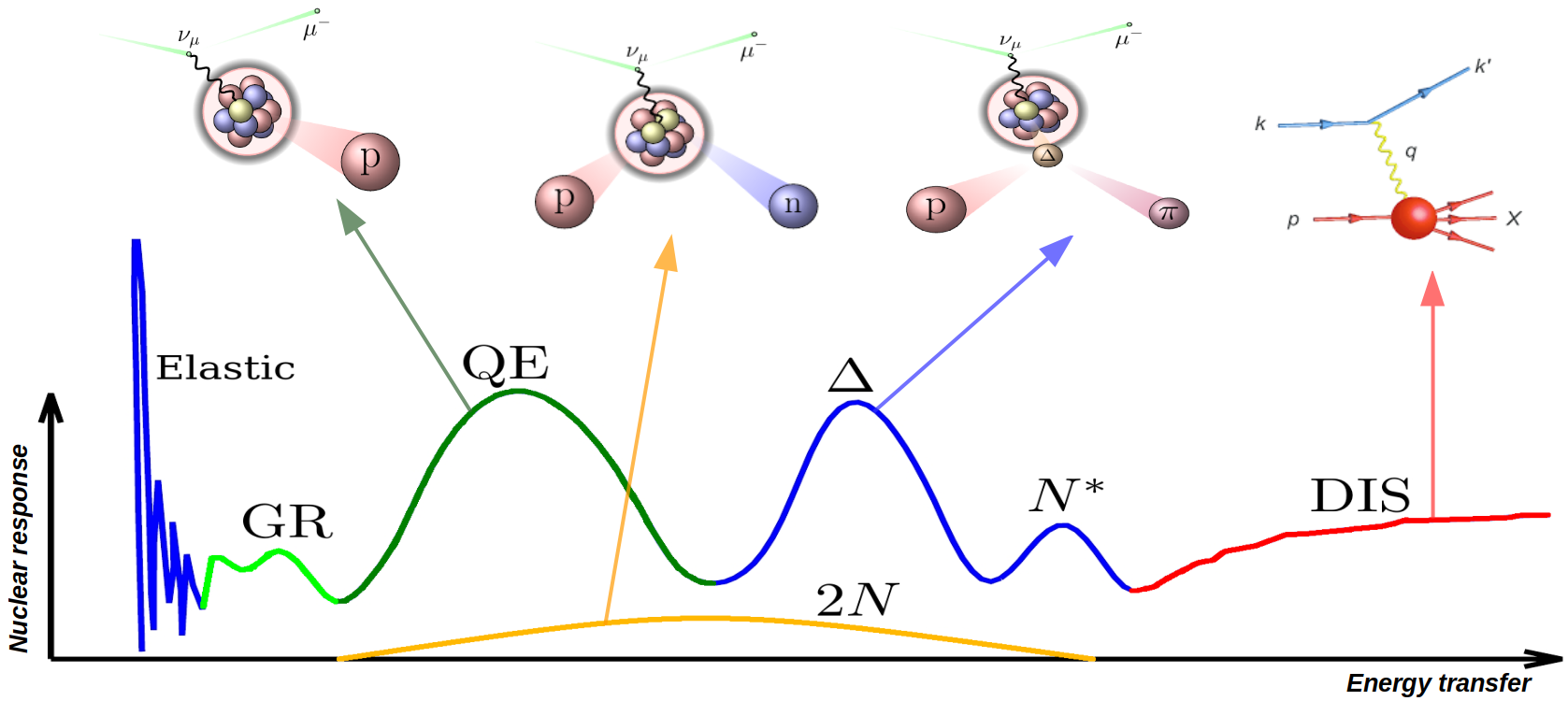
Reaction Mechanisms
Quasi-elastic scattering
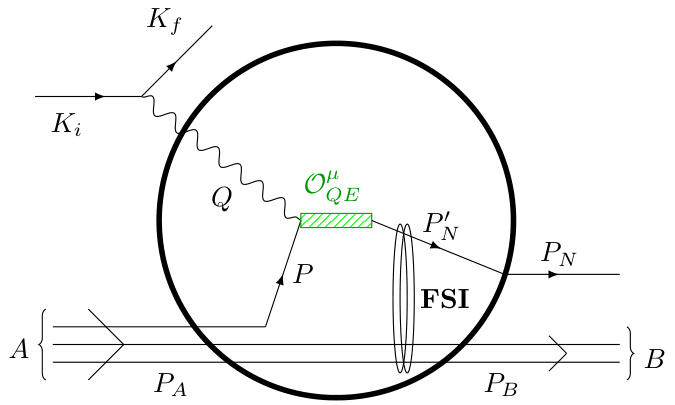
Quasi-elastic scattering occurs when a $\nu_\mu$ strikes an individual nucleon within a nucleus, providing enough energy to knock it out.
Pion production
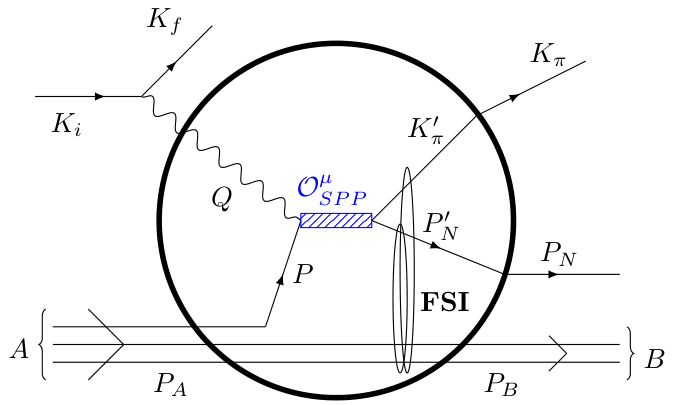
Beyond the elastic limit, a $\nu_\mu$ can excite nucleons into a $\mathbf{\Delta}$ -resonance that subsequently decays into a nucleon and a pion. Increasing the energy further unlocks higher resonances, which produce a nucleon along with one or more mesons.
Single-pion production is a key interaction channel in neutrino–nucleus scattering and plays an essential role in the interpretation of accelerator-based neutrino experiments. In high-energy experiments like DUNE 1 and NO$\nu$A 2 3, inelastic interactions that produce pions constitute a major contribution to the total neutrino–nucleus cross section. In experiments such as T2K 4, Hyper-Kamiokande, and the Short-Baseline Neutrino Program, single-pion production (SPP), dominated by $\Delta$-resonance region accounts for roughly 20% of all neutrino interactions 5 6 7. In this process, a neutrino interacts with a nucleon inside a nucleus, produces a resonance and subseqeuntly decays into a nucleon and a pion. In addition, SPP can also contribute to “0-pion” final states when a pion is absorbed or inelastic rescattered. This leads to an important background in the oscillation analyses. A precise description of pion production and nuclear effects are therefore essential to reduce systematic uncentrainties in the reconstructed neutrino energy.
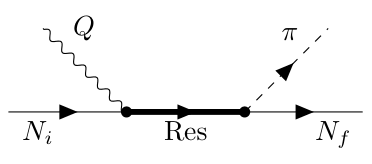
s-channel resonance diagram.
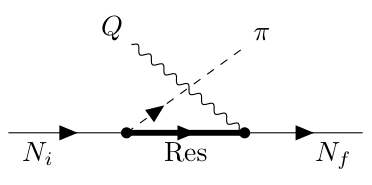
u-channel cross-resonance.
Our work focuses on the development of the Ghent hybrid model 8 for pion production, which combines a resonance describition with a tree-level background from chiral perturbation theory 9. The orginial low energy model including the $\Delta$ (1 232)-resonance is further extended with higher energy resenances $P_{11}$ (1440), $D_{13}$ (1520), $S_{11}$ (1535) 10 11 12 13 and the model is partialy untiterized in the $\Delta$-region through Olsson phases 14. The tree-level background diagrams are extended to higher energies using Regge theory 15 16 17 18. Recent efforts aim to improve the theoretical consistency of the model by uniterization all contributions using Watson’s theorem 19. This is achived by redefining the model in a multipole decompositions, and unitarizing the amplitudes through K-matrix theory.
In addition, we investigate the role of nuclear effects, in particular final-state interactions of the produced pions and nucleons 20. Inside the nucleus, produced particles like the nucleon and pion can be absorbed, elastic and inelastic rescattered which modifies the final state particles. These effects are crucial for reducing systematic uncertainties in neutrino oscillation experiments.
Two-nucleon knockout
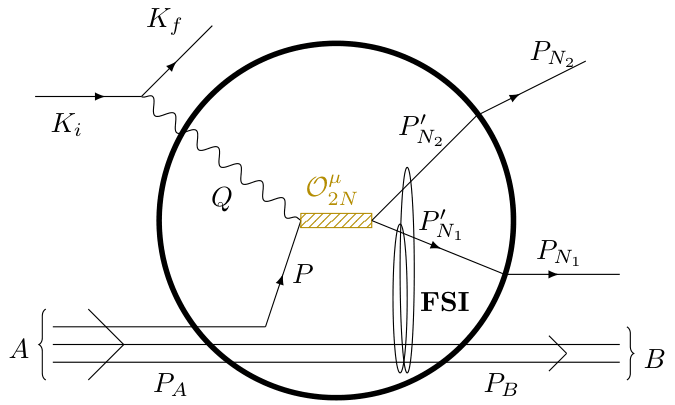
In two-nucleon knockout, a $\nu_\mu$ ejects not one, but two nucleons from the nucleus. This occurs when the nucleons form a correlated pair, transferring enough momentum to liberate both particles from the nucleus simultaneously.
Nuclear effects
Monte Carlo simulations
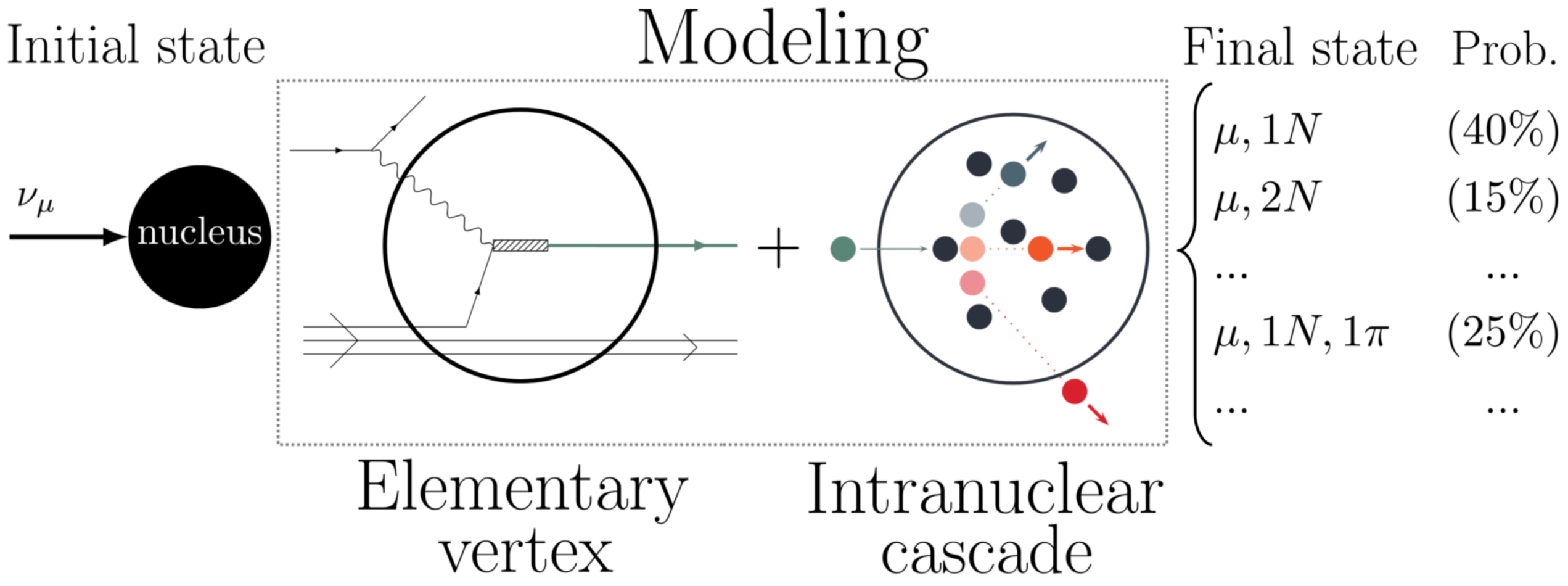
Monte Carlo Simulations

Event Generators
-
R. Acciarri et al. (DUNE), (2016). ↩
-
M. A. Acero et al. (NOvA, R. Group), Eur. Phys. J. C 80, 1119 (2020). ↩
-
M. A. Acero et al. (NOvA), Phys. Rev. D 107, 052011 (2023). ↩
-
K. Abe et al. (T2K), Nucl. Instrum. Meth. A 659, 106 (2011). ↩
-
T. Katori and M. Martini, J. Phys. G 45, 013001 (2018). ↩
-
J. Isaacson, W. Jay, A. Lovato, P. Machado, A. Nikolakopoulos, N. Rocco, and N. Steinberg, (2026), Single pion production and pion propagation in ACHILLES. Physical Review D, 113(3), 036005.. ↩
-
Hayato, Y., Pickering, L. The NEUT neutrino interaction simulation program library. Eur. Phys. J. Spec. Top. 230, 4469–4481 (2021). ↩
-
González-Jiménez, R., Jachowicz, N., Niewczas, K., Nys, J., Pandey, V., Van Cuyck, T., & Van Dessel, N. (2017). Electroweak single-pion production off the nucleon: From threshold to high invariant masses. Physical Review D, 95(11), 113007. ↩
-
Hernández, E., Nieves, J., & Valverde, M. (2007). Weak pion production off the nucleon. Physical Review D, 76(3), 033005. ↩
-
Hernández, E., Nieves, J., Singh, S. K., Valverde, M., & Vicente Vacas, M. J. (2008). ν induced threshold production of two pions and N(1440) electroweak form factors. Physical Review D, 77(5), 053009. ↩
-
Hernández, E., Nieves, J., Valverde, M., & Vicente Vacas, M. J. (2010). N–Δ(1232) axial form factors from weak pion production. Physical Review D, 81(8), 085046. ↩
-
Hernández, E., Nieves, J., & Vicente Vacas, M. J. (2013). Single π production in neutrino–nucleus scattering. Physical Review D, 87(11), 113009. ↩
-
Alvarez-Ruso, L., Hernández, E., Nieves, J., & Vicente Vacas, M. J. (2016). Watson’s theorem and the N–Δ(1232) axial transition. Physical Review D, 93(1), 014016. ↩
-
Olsson, M. G. (1974). Solutions of the multichannel unitarity equations describing the addition of a resonance and background: Application to a pole model of photoproduction. Nuclear Physics B, 74, 90115. ↩
-
Aznauryan, I. G. (2003). Multipole amplitudes of pion photoproduction on nucleons up to 2 GeV using dispersion relations and the unitary isobar model. Physical Review C, 67(1), 015209. ↩
-
Aznauryan, I. G., Burkert, V. D., Egiyan, H., Joo, K., Minehart, R., & Smith, L. C. (2005). Electroexcitation of the P33(1232), P11(1440), D13(1520), and S11(1535) at $Q^2 = 0.4$ and 0.65 $(GeV/c)^2$. Physical Review C, 71(1), 015201. ↩
-
Vrancx, T., De Cruz, L., Ryckebusch, J., & Vancraeyveld, P. (2013). The $p(\gamma, K^+) \Gamma$ reaction: Consistent high-spin interactions and Bayesian inference of its resonance content. Nuclear Physics A, 914, 74–78. ↩
-
T. Corthals, J. Ryckebusch, and T. Van Cauteren, Phys. Rev. C73, 045207 (2006) ↩
-
M. Hooft, A. Nikolakopoulos, J. García-Marcos, Y. De Backer, T. Franco-Munoz, K. Niewczas, R. González-Jiménez, and N. Jachowicz (2026). Optimizing the description of the Delta region in the Ghent Hybrid model for single-pion production.https://arxiv.org/abs/2603.29486 ↩
-
J. García-Marcos, T. Franco-Munoz, R. González-Jiménez, A. Nikolakopoulos, N. Jachowicz, and J. M. Udías (2024). Towards a more complete description of nucleon distortion in lepton-induced single-pion production at low-$Q^2$. *Physical Review C, 109 (2), 024608. ↩